
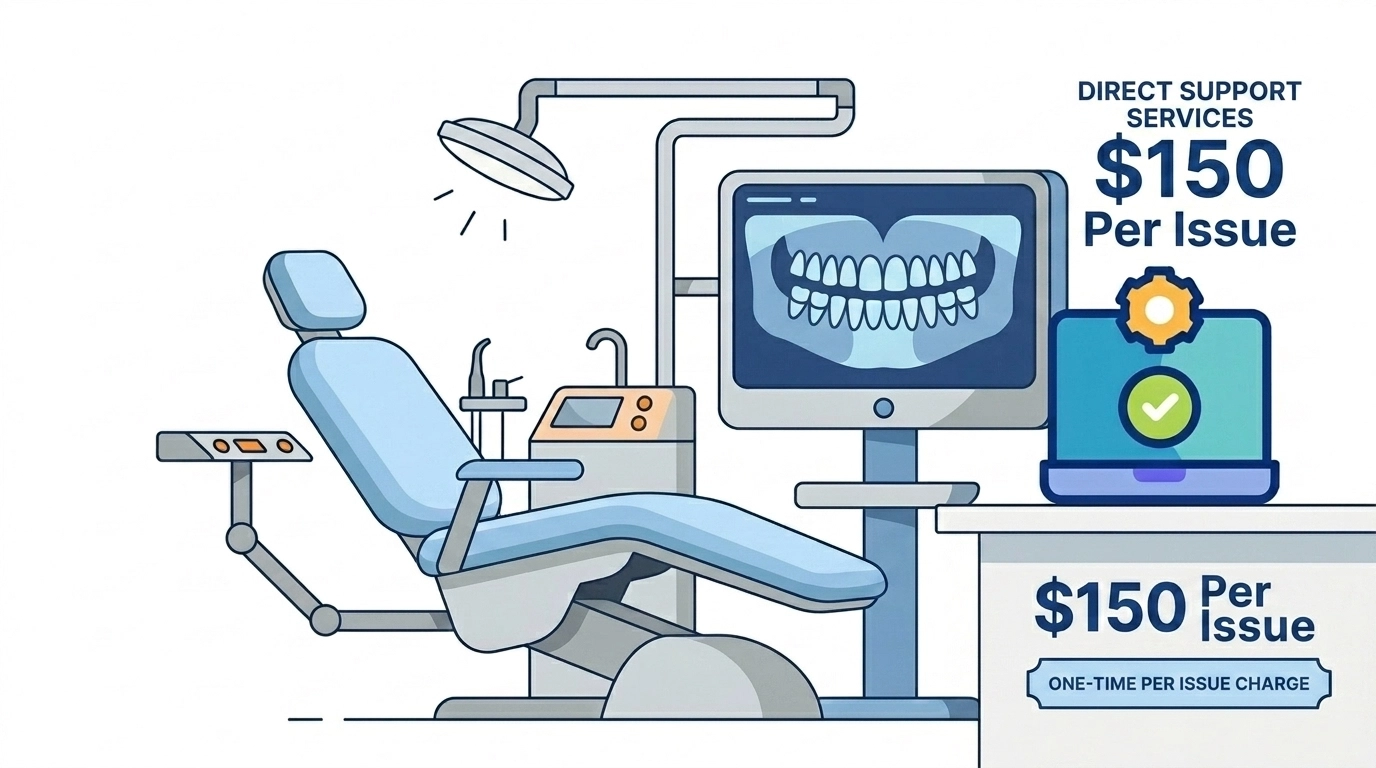
It is 8:15 AM on a Monday. Your waiting room is full. You have a patient in Chair 2 ready for a root canal, but OpenDental is hanging on the "Loading" screen. Your front desk just realized the printer: the one that handles patient consent forms: has gone offline.
In a dental practice, IT isn’t just "background noise." It is the central nervous system of your business. When the network lags or a sensor fails to sync an X-ray, you aren't just losing time; you’re losing patient trust and revenue.
Most dental offices settle for IT support that is either too expensive (bloated monthly contracts) or too slow (the "local guy" who might call you back by tomorrow). This guide cuts through the technical jargon to compare your options and show you how to choose a partner that understands the high-stakes environment of a modern clinic.
The Unique IT Demands of a Dental Practice
A dental office is not a standard business environment. You handle high-resolution imaging, strict federal compliance, and specialized practice management software that most general IT companies don't understand.
1. Practice Management Software (PMS) Support
Whether you use OpenDental, Dentrix, or Eaglesoft, your IT provider must understand how these databases function. If your server isn't correctly configured to handle the SQL traffic these programs generate, you’ll experience "micro-lags" that shave minutes off every patient interaction.
2. HIPAA Compliance and Data Security
HIPAA isn’t a suggestion; it’s a legal requirement. You need an IT partner that doesn't just "mention" security but actively implements it through:
- Encrypted Data Transit: Ensuring patient health information (PHI) is never sent over unencrypted channels.
- Unique User Identifiers: Ending the practice of shared passwords among the front desk staff.
- Multi-Factor Authentication (MFA): Protecting your email and practice management systems from unauthorized access.
3. Imaging and Network Speed
Digital X-rays and 3D scans create massive files. If your network isn't optimized for performance and speed, your staff will spend half their day waiting for images to load across workstations.
Key Takeaway: If your IT provider doesn't talk about SQL performance or PHI encryption in the first five minutes, they don't understand your business.
Comparing the Three IT Support Models
The "best" IT support depends on your budget and how you prefer to handle risk. Here is how the three main models stack up for a dental office.
Model A: Managed Service Providers (MSPs)
The traditional MSP model involves a long-term contract where you pay a monthly fee (often $100–$200 per user) regardless of whether you have a problem or not.
- The Appeal: They are "proactive." They monitor your systems 24/7.
- The Reality: You often pay for "shelfware": services and software licenses you don't actually need. For a 10-person dental team, this could mean $1,500 to $2,000 every single month, even when everything is running perfectly.
Model B: The "Local Guy" (Hourly Billing)
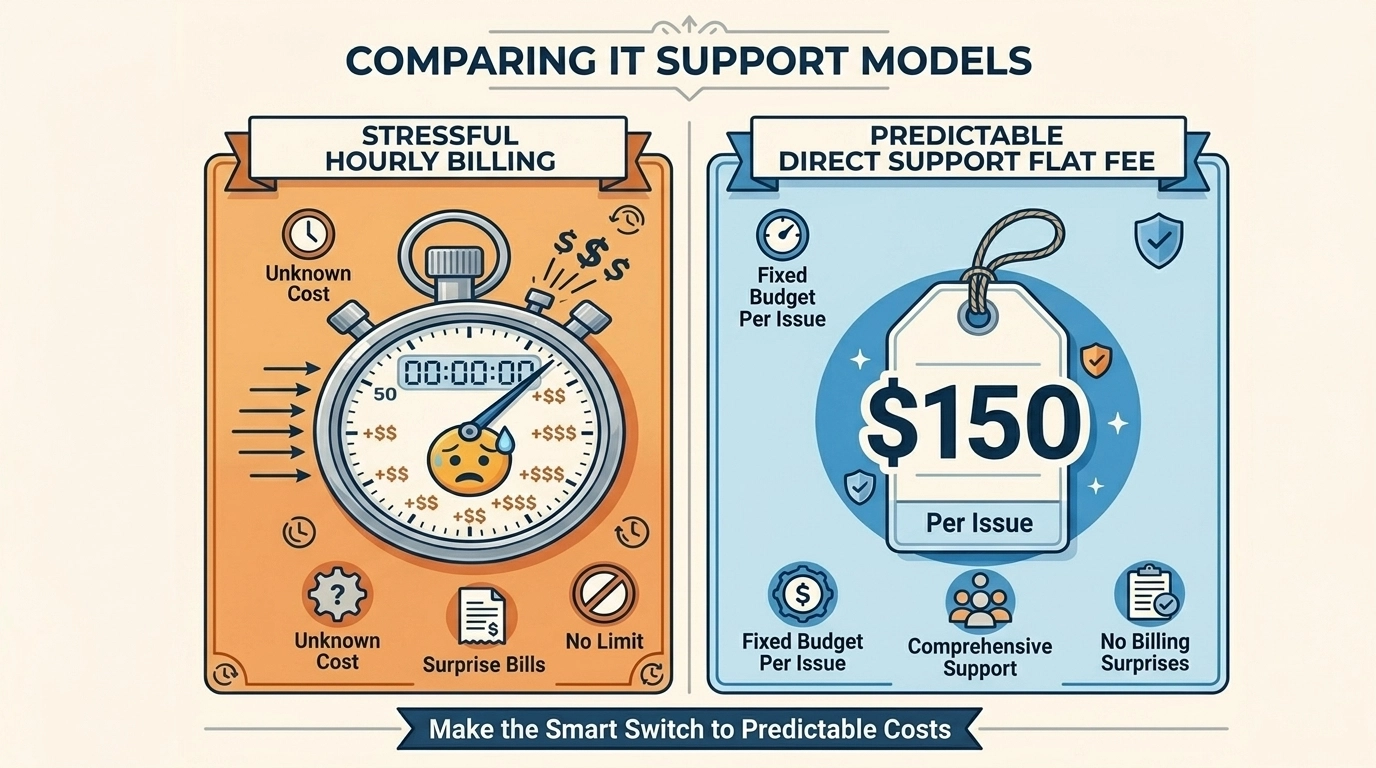
This is the classic "break-fix" model. Something breaks, you call him, he comes by (eventually), and bills you by the hour.
- The Appeal: No monthly fees.
- The Reality: The incentives are misaligned. The slower they work, the more they get paid. You also face "billing ambiguity": you never know if a simple printer fix will cost $100 or $400 until the invoice arrives. You can read more about the hidden costs of hourly IT to see why this model often fails growing practices.
Model C: The Flat-Rate Model (Direct Support)
This is a modern hybrid. You get expert IT help when something breaks, without monthly contracts or hourly billing traps. At Direct Support, we charge a flat rate of $150 per issue resolution, not per user per month.
- The Appeal: Pricing clarity. You only pay when you have a problem that needs to be solved. Whether a network issue takes 20 minutes or two hours to fix, the price is still $150. No recurring monthly per-user fees. No surprises. No "travel fees."
- The Reality: It forces the IT provider to be efficient. Because we charge per issue, our goal is to solve the problem permanently the first time so you don't have to call us back.
If/Then: Which Model Fits Your Practice?
- IF you have a multi-location practice with 50+ employees and a complex server farm, THEN a full-scale Managed Service contract might make sense.
- IF you are a solo practitioner or a medium-sized office that needs reliable help but hates "billable hour" surprises and doesn't want monthly per-user fees, THEN the $150 per issue flat-rate model is your best financial and operational fit.
- IF you enjoy waiting 48 hours for a callback and paying for travel time, THEN stick with the local hourly contractor.
5 Questions to Ask Your Potential IT Provider
Before you sign a contract or give anyone RDP access to your server, ask these five questions:
- "Are you U.S.-based?" Offshored support often leads to communication barriers and lag times that you cannot afford when a patient is in the chair. Direct Support uses only experienced, U.S.-based technicians.
- "How do you handle HIPAA compliance for remote access?" They should be able to explain their use of encrypted tunnels and unique audit logs.
- "Is there a contract?" If they try to lock you into a 12-month or 36-month commitment, walk away. Modern IT should be good enough to earn your business every time you have a problem.
- "What is the cost for a single issue?" If the answer involves "minimum hours" or "tiered pricing," it’s not transparent. Demand a flat fee.
- "Do you support OpenDental/Dentrix?" They should know the difference between the software's local database and its cloud components.
The Direct Support Advantage for Dentists
At Direct Support, we specialize in the "pragmatic" approach. We know that in a dental office, speed is the only metric that matters.
We don't want to manage your entire life; we want to solve your tech problems so you can get back to your patients. Our $150 per issue model means you pay only when you need a problem solved, with no recurring monthly fees per user. It covers:
- Computer and Mac Support: From slow boot times to software crashes.
- Network Issues: Troubleshooting the Wi-Fi or the ethernet backbone that carries your digital X-rays.
- Microsoft 365 & Email: Ensuring your communication is secure and reliable.
- Cybersecurity: Removing viruses and setting up the defenses that keep your practice HIPAA-compliant.
- Printer & Peripheral Setup: Because a dental office that can't print a treatment plan is an office that can't close a sale.
Key Takeaway: You shouldn't need a PhD in computer science or a recurring per-user monthly bill to keep your dental office running. You just need a technician who knows what they’re doing and a flat $150 price when something actually needs to be fixed.
Summary: Cut the Headache, Keep the Tech
The "best" IT support isn't the one with the flashiest marketing; it's the one that stays out of your way until you need them, and then solves the problem instantly for a price you already know.
If you’re tired of the billing ambiguity of hourly IT or the suffocating costs of monthly managed services, it’s time to switch to a direct model. At $150 per issue, with no contracts and no recurring monthly per-user fees, Direct Support is the logical choice for modern dental practices.